Research proposal TAC-2026-01 · Version 1.1. Published by TACITUS. Independent peer review has not been completed. The efficacy studies described here are proposed, not preregistered or run.
Keywords: context capsules; knowledge graphs; retrieval-augmented generation; provenance; collaborative writing; human–agent handover.
1 Problem and candidate contribution
An analyst revising a policy note needs more than a relevant paragraph. They may need the exact source edition, the condition limiting its applicability, the reason a team retained cautious wording, and an objection that remained unresolved. When this work moves to another conversation, teammate or agent, these dependencies can disappear. The recipient may produce a plausible answer while changing the meaning of the earlier analysis.
TACITUS App organizes work around conversation and writing with explicitly attached context. A capsule packages a purpose, selected sources and working guidance. An artefact is a reusable format, example or resulting work product. A small graph records selected relationships among passages, interpretations, conditions, discussions and review decisions. The graph supplies structure to context selection and inspection; generation receives a bounded packet, not an image of the graph or the entire knowledge store.
The candidate contribution is a portable contract connecting three otherwise separable operations: selecting evidence for a request, preserving the scope and review history of its interpretation, and retaining that context when a work product is reused. This can be implemented using ordinary records and typed edges. Its research value depends on whether the contract improves continuity and accepted work, rather than on a new graph class or foundation model.
The central question is: Does reusable, reviewed context preserve critical qualifications and team decisions across generation, source updates and handover, at an acceptable total cost? Three hypotheses follow. Dependency-aware selection may prevent known conditions from being separated from a claim. Explicit versions may help recipients distinguish a source update from a changed recommendation. Reusable context may reduce repeated explanation. Each has a competing explanation: a careful ordinary note may achieve the same outcome, and annotation and review may cost more than reuse saves.
2 Relation to existing research
Retrieval-augmented generation combines generation with retrievable external information (Lewis et al. 2020). Long-context research shows that the position of relevant evidence can affect its use (Liu et al. 2024). These motivate testing selection and placement, but neither establishes that shorter context or a particular graph improves every model. BM25 is an important reproducible comparator (Robertson and Zaragoza 2009). BEIR further demonstrates why retrieval evaluation should include varied architectures and the computational costs of reranking (Thakur et al. 2021); a lexical-only baseline is insufficient to establish a practical advantage over a capable contemporary system.
GraphRAG studies entity graphs and community summaries for corpus-level questions (Edge et al. 2024). HippoRAG uses knowledge graphs and Personalized PageRank for knowledge integration and multi-hop retrieval (Jiménez Gutiérrez et al. 2024). LightRAG combines graph and vector representations with retrieval at different levels (Guo et al. 2025). TACITUS’s public reference instead operates on authored mappings with deterministic selection and explicit qualifications. The proposed distinction is a reusable, review-scoped context contract across tasks and actors. The evaluation must establish whether this integration adds useful capability beyond these existing approaches.
Self-RAG studies learned conditional retrieval and reflection (Asai et al. 2024), while ReAct studies interleaving reasoning and task actions (Yao et al. 2023). They motivate conditional evidence access and bounded agent tools. The current TACITUS reference does not implement their learned policies. LongMemEval’s separation of cross-session reasoning, temporal updates and abstention is directly relevant to handover (Wu et al. 2025). Unlike automatic memory over an entire interaction history, a capsule is deliberately selected and can be reviewed for a stated purpose.
ALCE, Attributable to Identified Sources and FActScore motivate separate measurements of citation quality, attributable statements and individual factual claims (Gao et al. 2023; Rashkin et al. 2023; Min et al. 2023). A resolving citation identifier does not establish a supported paraphrase. PROV-O and SHACL inform provenance and declared graph constraints (Lebo, Sahoo, and McGuinness 2013; Knublauch and Kontokostas 2017). Structural validation and semantic correctness remain different questions.
Human–AI interaction research motivates correction and control over adaptation (Amershi et al. 2019); model cards motivate explicit reporting of intended use and evaluation scope (Mitchell et al. 2019). Model explanations can also misrepresent the process producing an answer (Turpin et al. 2023). Accordingly, recorded reasoning here means attributed discussion, analytical warrants, objections and explanations of wording. It does not denote an authenticated record of a model’s private chain of thought.
3 The portable context contract
3.1 Records, roles and review
The contract distinguishes an external source statement, an interpretation of it, a working instruction, and a generated result. A source record identifies its edition and exact passages. An interpretation preserves its author, modality, scope and supporting spans. An instruction states how the team wants to perform the work. A draft records its dependency on selected context and subsequent edits. An example artefact can guide form without transferring its factual contents to a new situation.
| Record | Required role in the contract | Failure it helps expose |
|---|---|---|
| Source edition and passage | Stable identity, exact text, locator and content pin | A quotation drawn from the wrong edition |
| Interpretation and qualification | Attributed claim, conditions, exceptions and declared support | A permission presented as an accomplished decision |
| Discussion and working decision | Contributor, stated rationale, disagreement and intended use | A later writer losing why cautious language was chosen |
| Capsule and artefact | Purpose, selected versions, output requirements and reuse scope | A template’s example content treated as new evidence |
| Review and execution record | Exact reviewed content, authority, dispatch selection and outcome | An old approval or an undispatched preview mistaken for current acceptance |
Human acceptance should bind to the exact interpretation, its source dependencies and its intended use. The record should identify who reviewed it, what they checked and what would require another review. Source changes, revocation or a changed task can make an earlier acceptance unsuitable for new use. The public reference emits proposed interpretations; the App uses separate interpretation-review and graph-activation contracts. A model critic supplies another interpretation and cannot grant human acceptance.
3.2 What the graph contributes
The graph records typed relationships such as a passage supporting an interpretation, a condition qualifying it, or a discussion explaining a wording decision. An ontology declares the vocabulary and permitted relationships; a task layer selects the records and checks relevant to a particular job. Neither supplies evidence absent from the source collection.
“Small graph” denotes a bounded task projection rather than a fixed ideal number of nodes. The complete case graph and the model input are different objects. More nodes may expose useful dependencies, but can also add irrelevant material or amplify an annotation error. The intended benefits are inspectable dependencies, explicit reuse and targeted updates; improved output quality must be measured.
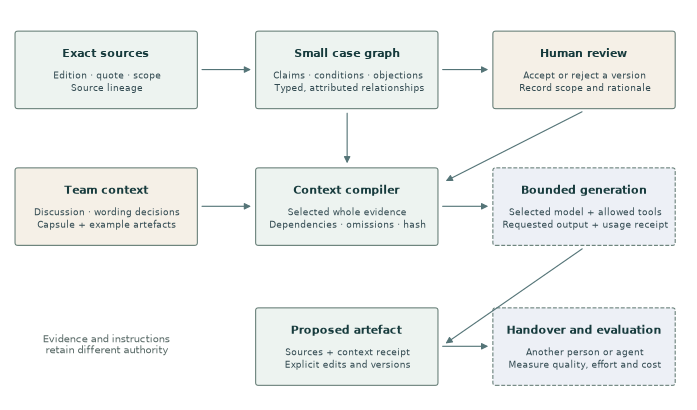
The contract can be serialized as ordinary JSON, tables or prose. A graph visualizer is a review interface. A graph index is a retrieval mechanism. A graph serialization is a prompt representation. These are distinct interventions, so the evaluation should vary them separately rather than attributing every improvement in a complete pipeline to “the graph.”
4 Executable selection and assembly
4.1 Reference algorithm
The public reference is a credential-free Python implementation operating on explicit source text and authored annotations. Its implemented procedure is:
- Validate the collection. Require unique identities, attributed source URLs and content hashes. Check exact Unicode code-point quotation spans, relation domain/range and declared qualification spans. Every reference interpretation remains proposed.
- Select an authored task layer. The layer declares eligible statements, required statements and reviewer checks. Optional BM25 selection ranks quotation and interpretation text. Graph selection seeds from matches and expands through shared subject/object entities for at most two hops, recording inclusion reasons.
- Assemble required statements first. A selected statement travels with its complete quotation, qualification records, source edition, relation and endpoint entities. The source register retains attribution and rights notes.
- Apply a byte gate. Canonical UTF-8 JSON for the required packet must fit the budget. Otherwise assembly refuses. The core packer then considers optional statements in stable identifier order and includes a whole statement only when the resulting packet fits.
- Emit distinct outputs. Return the full selected-layer graph, bounded capsule, evidence worksheet, omissions and a checksum receipt. The App import bundle additionally carries the exact source collection and ontology for independent validation.
This describes actual code rather than an unspecified optimal utility function. The graph option changes eligible selection; the core packer is not a learned ranker and does not solve a globally optimal packing problem. Required layer statements remain mandatory, even if their count exceeds a requested optional-selection limit; the complete-packet byte gate still applies. The implementation must be evaluated at these actual boundaries.
Three useful invariants are enforced: a retained quotation matches its pinned source span; a declared required qualification is retained with its statement; and a mandatory packet that exceeds budget is refused as a whole. These invariants cover declared dependencies. They cannot identify an exception that was never annotated, determine legal applicability or establish the truth of an interpretation. Such errors require separate source review and tests.
4.2 App projection and dispatch
The reviewed App source has a separate selector using lexical inverse-frequency matching, selected graph anchors and adjacent qualification handling. Its graph-context contract bounds selection to four graphs, 128 nodes, 256 edges, 24 KiB of graph context and 65,536 bytes for the complete packet. These are operational limits, not experimentally selected optima. Python code-point offsets are mapped to the App’s UTF-16 convention against exact original text.
The proposed dispatch contract retains the selected object and source versions, graph selection, packet hash, requested and reported model identity, settings, observed usage and resulting artefact. Conversation and Writing should share the same evidence contract. A local model may be another generator behind it, but local inference and hosted storage have separate data and resource boundaries. Historical receipts remain identifiable after a source update; new dispatch checks current access and eligible review state.
5 Source-update and handover case
5.1 A real identifier collision
The archived April 2024 draft and July 2024 final editions of NIST AI 600-1 provide a concrete source-maintenance problem (National Institute of Standards and Technology 2024a, 2024b). In their MEASURE 2.5 tables, the action advising source-and-citation verification has the same wording, including pre-deployment measurement and ongoing monitoring. Its identifier changes from MS-2.5-008 in the draft to MS-2.5-003 in the final. The draft’s MS-2.5-003 describes a different security-assessment practice.
| Pinned edition | Identifier | Practice in the captured passage |
|---|---|---|
| April draft, printed p. 39 | MS-2.5-008 | Source-and-citation verification |
| July final, printed p. 31 | MS-2.5-003 | The same verification wording |
| April draft, printed p. 39 | MS-2.5-003 | Security assessments and integrity audits |
An analyst updating an internal review note should change the edition-bound citation while retaining the verification practice and its timing. Looking up only the final identifier in the draft would retrieve a different practice. A useful handover therefore carries all three spans and the authored rationale: change the reference, retain the cited advice, and distinguish the same-number collision. NIST describes suggested guidance; the example must preserve that modality rather than turn it into a statutory obligation.
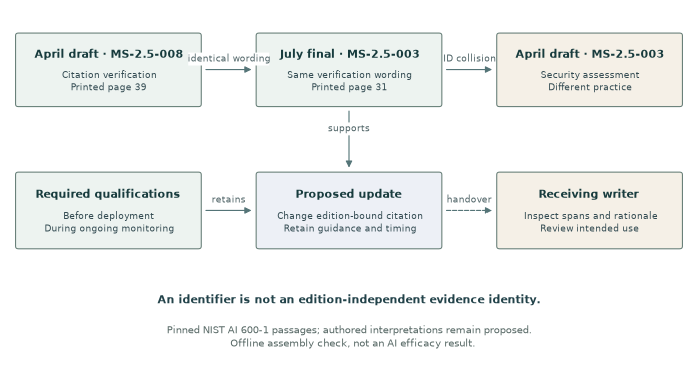
The publication replay checks the exact captured text hashes, offsets and wording equality, then rebuilds a capsule containing three proposed statements from two source records. The recorded packet uses 4,726 canonical UTF-8 bytes at a 24,000-byte budget. Its source capture records official PDF hashes and extraction rules; optional verification against those PDFs is available in the reference fixture. The replay establishes this assembly result, not better AI generation or saved analyst time.
A careful ordinary note could express the same information. That is
precisely why the evaluation must compare a capsule with a well-prepared
note, not merely with a question lacking the relevant context. The case
is development material already inspected by the builders and must be
excluded from held-out efficacy testing. The package’s
source-edition-case.json makes the source-to-interpretation
mapping inspectable.
6 Available evidence and its scope
Source validation, reference assembly and import contracts can be exercised without a model. The reviewed App source also includes context previews, saved objects, graph selection and interpretation-review records. The documented hosted release keeps generation paused; a configured model or billing guard is not end-to-end execution acceptance. This proposal does not establish a fresh audit of every deployed App feature.
Six historical direct Cloudflare provider requests on 23 November 2026 used one synthetic renewal question, with flat and graph-annotated arms for three model families. All six returned valid response structures and resolving citation identifiers. Qualitative review found that Gemma’s flat answer omitted a required condition, while its graph-assisted answer retained it; GPT-OSS retained the material distinctions in both arms; GLM’s graph-assisted answer strengthened the action’s procedural status and omitted duration.
These observations were post-hoc, unblinded and AI-assisted. The graph arm added annotations, including a potentially misleading proposed-action label, so the arms were not information-equivalent. The recordings support provider compatibility and identify failure cases. They neither estimate an average quality effect nor validate the deployed App route. Their exact inputs, final answers, usage and hashes remain in the historical public record; this revision makes no new model calls.
7 Proposed evaluation
7.1 Comparators that can challenge the claim
The primary practical comparison should use a strong retrieval system: lexical and dense candidates with a registered fusion and reranking procedure, selected on development collections and frozen before testing. Its actual retriever, embedding model, reranker, index cost and token limits must be disclosed. BM25 remains a useful inexpensive ablation rather than the sole primary comparator.
| Arm | Information and preparation | Question addressed |
|---|---|---|
| A: full context and note | Eligible source documents plus a carefully prepared working note | Can ordinary context already solve the task? |
| B: strong retrieval | Frozen hybrid retrieval, reranking and ordinary source metadata | Does the complete capsule pipeline improve useful work? |
| C: reviewed flat packet | The same selected evidence, instructions, qualifications and relation meanings as D, rendered linearly | What does reviewed content achieve without graph serialization? |
| D: capsule and graph | The reviewed packet with explicit typed relationships and dependency records | Does the proposed integration and representation add value? |
Within paired contrasts, freeze the model snapshot, source pool, task, system instructions, answer format, decoding settings and output cap. Report actual input tokens and information content, and include matched-budget sensitivity analyses when encodings differ. A hosted model and a runnable local model can form separate blocks after their routes and resources are accepted. Full-document cases must be identified before results, and model substitutions require a new recorded block.
7.2 Tasks, review and analysis
Start with at least 24 feasibility tasks across disjoint collections. A provisional confirmatory design is 120 tasks from 30 collections; its final size requires clustered power analysis from feasibility estimates before the held-out set is unlocked. Register the resulting sample, stopping rule, primary contrast, exclusions and analysis. These are planning quantities, not a completed or adequately powered trial.
An independent panel should create held-out questions and prelist their critical facts, qualifications, source editions and acceptable abstentions. Include analytical writing, conflicting accounts, source updates, changed identifiers, multilingual modality and missing evidence. Freeze case annotations before builders see held-out questions or reference answers. Separate source preparation, retrieval and generation so the analysis can locate the stage of a failure.
The primary endpoint is clean task completion: a valid completion handles every critical point, including justified abstention where required, and contains no consequential unsupported claim. Failed, missing and timed-out attempts remain assigned tasks. Two independent domain reviewers assess shuffled, de-identified answers using the frozen rubric, with adjudication and recorded disagreements. Content can reveal an arm despite removed labels; this limitation should be assessed. Automated judges are secondary and require calibration against human judgments.
For paired task , let denote clean completion under arm . The primary effect is
Use uncertainty intervals resampled at the source-collection level, retaining complete clusters. Report effect sizes, all failed runs and reviewer agreement. Treat D–C, eligible A comparisons and subgroup analyses as secondary, with prespecified multiplicity handling or exploratory labels. Secondary measures include supported-claim precision and coverage together, retained conditions, actor/edition accuracy, correct updates, critical-span retrieval and useful revisions. Precision alone can reward an incomplete answer.
7.3 Mechanisms, handover and cost
Vary context budget, evidence position and graph size within actual runtime limits. Remove prior discussion, typed organization or dependency closure in separate ablations. Test incorrect annotations, same-name actors and outdated review records. A graph can spread a mistaken interpretation more consistently; adverse cases are a central outcome, not noise to discard.
For handover, give a recipient an unfinished analysis after another analyst establishes its context. Compare ordinary documents and history with a capsule and artefact; balance recipient experience and task assignment, using separate cases to reduce learning carryover. Measure rationale-recovery time, consequential errors, clarifying questions, recognition of unresolved objections and time to an accepted result. A bounded agent can be a later recipient condition under the same allowed evidence and actions.
Count preparation, annotation, review, indexing, retrieval, inference, failures, maintenance and revision. Attribute one-time construction costs across observed reuse rather than assuming unlimited future reuse. Report quality at the same budget and total cost at the same acceptance threshold. A system that saves input tokens but increases review time may have no economic advantage. The handover study requires consent and a fixed analysis protocol before participant work.
8 Engineering boundaries and deployment
The initial design needs versioned records, exact-source storage and bounded traversal; a specialized graph database is optional. More infrastructure should follow measured workload needs. Schema checks should identify the operation performed—such as quotation identity—rather than present an undifferentiated trust score. Review authority, source rights, access scope and retention remain application responsibilities.
Retrieved material can contain indirect prompt injection (Greshake et al. 2023). Source text and graph annotations must remain task data, with server-side tool permissions and access controls. Separate integrity tests should cover tampered spans, forged approval metadata, revoked access, oversized packets and uncertain duplicate dispatch. Multiple model stages do not create independent evidence, and generated explanations remain attributed proposals.
Deployment should progress through packet integrity, authenticated attachment and revocation, bounded dispatch and accounting, held-out evaluation, and measured team pilots. Software tests establish specific contracts, while truthfulness, legal applicability and customer value require separate evidence. Recurring tasks may amortize preparation; ordinary retrieval may better serve one-off questions.
9 Conclusion and disclosures
TACITUS proposes a reusable context contract across evidence selection, generation, updates and handover. Its reference algorithm enforces declared identity and qualification rules; the NIST case demonstrates a versioning problem. Graph organization, output quality and productivity remain empirical questions for the proposed comparisons.
TACITUS is the author, developer and publisher, with a commercial interest. Proposal TAC-2026-01, version 1.1 has not undergone independent peer review; confirmatory studies have not been run or preregistered. AI assisted writing, source/code inspection and historical qualitative review, not independent domain review. Literature selection was targeted, not systematic. No endorsement or registered DOI is claimed.
Appendix. Materials and reproduction
The package includes the manuscript, twenty-one references, vector figures, source-edition case, proposed protocol, implementation-status record and checksums. The earlier synthetic compatibility replay remains separate development material. Private App code and customer documents are excluded. Source rights, NIST attribution and capture rights notes are retained.
Reviewed public reference commit:
9fa96f66593902c5631efc391ef449a9c724b958. Private App
source-review pin:
2f11863ed506502a2bc508840a8e4d30ff69f15f; this does not
publicly reproduce the application. From the repository root, Python
3.11+ runs research/context-capsules/v1.1/replay.py and
verify.py without credentials or inference. Publication
rebuilding also requires Matplotlib, Pandoc/citeproc and XeLaTeX.
Version 1.0 remains archived.