v0.4 publication · 18 actual PDF pages
Reading public discourse with evidence
Start with the research question, then follow source wording, represented speakers, framework conditions and uncertainty. Diagrams explain the method and its limits.
DOXA by TACITUS · Bias Detection as a Service
A document workbench for examining what a collection asserts, assumes and contests—with the source behind every interpretation.
Open-source service toolkit · Local or your cloud · Research preview
Whose words?
Which framework?
What is still uncertain?
From collection to review
Choose the question, analytical criteria and reviewer perspective. Keep source wording, model interpretation and human judgment separate throughout.
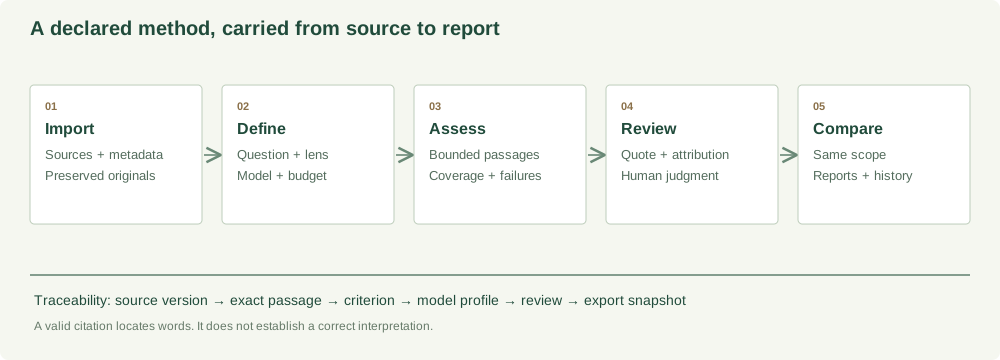
Examine prejudice, framing, language norms or another defined concern. IHRA, Jerusalem Declaration and Nexus remain distinct frameworks, alongside anti-Muslim-prejudice and custom rubrics.
A quoted remark, a training example and an institution’s position are different evidence. Check speech role, target, stance and surrounding text before drawing a conclusion.
Explore evidence, publication-time trajectories and review history with a visible run, filters and coverage. Download PDF, HTML, XLSX, CSV or JSONL records.
Two ways to begin
Start the browser interface on your computer. SQLite and files hold the workspace; an optional local model keeps inference on your machine. CPU speed depends on the selected model and hardware.
Deploy the shared Python engine with authenticated routing, durable jobs and object storage. Cloudflare and compatible inference providers are configurable; provider charges remain yours to control.
Deployment options and limits ↗A deeper way into the evidence
Three illustrated publications explain the research, then expose the underlying records. The commentary is AI-authored guidance; it is not independent human adjudication. Original v0.3 results remain explicitly versioned.
v0.4 publication · 18 actual PDF pages
Start with the research question, then follow source wording, represented speakers, framework conditions and uncertainty. Diagrams explain the method and its limits.
v0.4 publication · 38 actual PDF pages
Fifteen real cases connect passages and source credits to the proposed reading. Original model assessments, later AI-authored commentary and unresolved questions stay separate.
v0.4 publication · 36 actual PDF pages
Inspect version lineage, evidence contracts, source and method provenance, processing flows, references and reproducibility. Software fidelity is distinguished from interpretation accuracy.
The independent reference-review scaffold is available, but qualified human annotation and adjudication remain pending. There is no measured interpretation-accuracy claim.
Recorded software replay: a CI run exported all 5,000 sources and 204,342 recorded assessments without fresh inference. Source/assessment identities and archive checks passed. Inspect the measured software-fidelity receipt ↗. The original run’s partial coverage and unresolved decisions remain visible; this is not semantic validation.
From inspection to publication · v0.4
Pin recorded assessments across all four outcomes, or include an actual unresolved source unit. Order the cases and state why each belongs. Frozen source anchors and framework conditions stay with the draft.
Original model output, a captured review overlay and operator editorial notes remain separate. A selected casebook illustrates an inquiry; its selection does not estimate prevalence or establish interpretation accuracy.
Queue PDF, HTML, XLSX, CSV or JSONL exports from a frozen selection. Inspect progress, cancel or restart, then download verified files with source credits and checksums. Report preparation makes no fresh model calls.
Local jobs recover from saved state. The cloud adapter uses durable queue dispatch and private object storage; capacity is subject to deployment limits and explicit staging validation.
Recorded evidence
The contextual v3 run retained 11,701 criterion assessments across 20 public institutional sources. 613 of 616 contextual units are fully assessed (99.5%). The run remains partial.
18 of 20 source documents are fully assessed; 3 criterion assessments remain unresolved. Source anchoring is checked. Independent interpretation accuracy has not been established.
A separate 5,000-article news run retains 204,342 assessments, with 99.3% contextual-unit coverage and an explicitly partial result.
Open the recorded run and commented PDFs →A useful first engagement
TACITUS can help scope a collection, develop a rubric, configure your deployment and organize expert review. Agree the evidence, evaluation and deliverables before work begins.
Discuss a DOXA project ↗Open-source software. Optional consulting by agreement. Run locally or bring your own cloud; there is no hosted account or checkout on this website.